
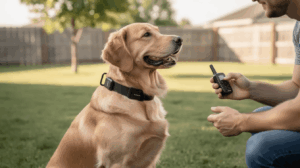
E-collar training for beginners starts with one essential truth: the collar itself is not the training. Before considering a remote training collar, your dog needs a solid foundation in basic obedience, and you need a clear understanding of the potential welfare risks, proper equipment handling, timing, and communication.
This guide covers what an e-collar is, the foundational skills your dog should develop before introducing additional training tools, important safety considerations, and when professional guidance is necessary. It does not provide step-by-step stimulation protocols. Instead, it helps dog owners make informed, responsible decisions about whether this type of training tool is appropriate for their situation.
Here is the direct answer: an e-collar can deliver an electrical stimulus, and some models also provide tone or vibration. Depending on how these signals are used and experienced by the dog, they can function as aversive consequences rather than neutral communication. E-collars are not a shortcut to obedience, and current veterinary behavior guidance recommends using reward-based methods instead. Owners should understand the documented welfare concerns and consult an appropriately qualified professional before considering any aversive training tool.
By reading this article, you will:
- Understand what e-collars are and how their features can vary
- Learn why reward-based foundational obedience should come first
- Recognize stress signals that may indicate your dog is overwhelmed or confused
- Know when to seek help from a veterinarian, qualified dog trainer, or veterinary behaviorist
- Understand the safety concerns associated with e-collar use
- Explore reward-based alternatives for recall and obedience training
Key Takeaways
- E-collars are aversive training tools, not shortcuts. Static stimulation affects behavior through a sensation the dog may seek to avoid.
- Foundational training should begin with reward-based methods. Dogs need to understand the requested behavior before owners attempt to reinforce it at greater distances or around distractions.
- There is no universal long-line training period or readiness score. Progress depends on the individual dog, environment, behavior, and training goals.
- Fear, anxiety, aggression, and reactivity require professional evaluation. A veterinarian or appropriately qualified behavior professional can help identify medical and behavioral factors.
- Research has not shown that e-collars are necessary for effective recall training. Reward-focused methods can produce equal or better results with fewer documented welfare concerns.
- Safety requires careful attention to fit, skin condition, equipment condition, and the dog’s emotional response.

Understanding E-Collar Training for Beginners
An e-collar, also called a remote training collar, is a device worn around a dog’s neck and operated through a handheld transmitter. Depending on the model, the collar may provide an audible tone, vibration, or static electrical stimulation. Available features, intensity scales, and operating ranges vary significantly between products.
The terms “e-collar,” “remote collar,” and “shock collar” are often used to describe devices capable of delivering an electrical stimulus. Some modern models offer adjustable settings and additional signals, but these features do not eliminate the potential welfare risks. Tone and vibration may also become aversive if the dog finds them startling, uncomfortable, or associated with an unpleasant consequence.
An e-collar does not teach your dog what “sit,” “come,” “stay,” or “heel” means. Those behaviors must first be taught through clear instruction, repetition, and reinforcement. Treating a remote collar as a shortcut around basic obedience training can create confusion, stress, and unintended behavior.
Build Foundational Obedience First
Before considering any remote training device, your dog should have a clear understanding of basic cues developed through positive reinforcement and reward-based training. This foundation helps your dog understand what you are asking and gives you safer ways to build reliability.
Essential Commands to Teach
Useful foundational cues include:
- Sit and down in familiar environments
- Stay for gradually increasing durations
- Come or another consistent recall cue
- Place or settle on a designated surface
- Walk politely on a leash
- Leave it or disengage from an item
- Look or respond to an attention cue
There is no universal success percentage that determines whether a dog is ready for more advanced training. Instead, look for comfortable, consistent responses in environments where your dog can remain focused.
If your dog appears confused, fearful, distracted, or unable to respond, reduce the difficulty. Increase distance from distractions, return to an easier exercise, and reinforce successful responses.
Why Reward-Based Training Comes First
Research supports using food, play, praise, and marker training to establish new behaviors. A controlled study involving 63 dogs with off-leash behavior concerns compared reward-focused training with e-collar and mixed-method approaches.
The reward-focused group responded more quickly and was more likely to respond to the first cue. The researchers found no evidence that e-collars were necessary for the training goals studied.
Reward-based training also helps build motivation and confidence. When a dog understands that an appropriate response leads to something positive, training becomes clearer and more engaging.
The Long-Line Foundation
A long line can help owners practice recall at a distance while maintaining physical control. There is no fixed number of days or weeks that every dog must spend on long-line training. Progress depends on the dog’s learning history, the handler’s skills, the environment, and the level of distraction.
Choose a line and training area appropriate for your dog’s size and experience. Avoid locations where the line could become tangled around people, animals, trees, or equipment.
During long-line training, focus on building reliable recall and obedience through food, play, praise, and gradual increases in distance and distraction. Reward your dog generously for turning toward you and returning promptly.
Important E-Collar Safety Considerations
E-collars carry physical and behavioral risks. Even if an owner is only researching these devices, understanding those risks is essential.
Fit and Equipment Safety
An improperly fitted or poorly maintained collar may cause discomfort, skin irritation, pressure injuries, or inconsistent contact. There is no universal “two-finger rule” that applies to every e-collar, dog, or coat type. Owners should follow the manufacturer’s fitting and wear instructions carefully.
Before using any collar or training equipment, inspect:
- The strap and fasteners for damage or excessive wear
- The receiver and contact points for corrosion, dirt, or damage
- The charging components and transmitter for visible defects
- The dog’s neck for redness, swelling, sores, hair loss, or sensitivity
- The dog’s behavior for scratching, avoidance, or signs of discomfort
Remove the equipment if irritation or pain is present. Contact a veterinarian if skin changes, swelling, sores, or discomfort persist.
Stimulation Levels and Timing
There is no universal working level that is appropriate for every dog. Numbered scales also differ between manufacturers, so a particular setting on one device cannot be safely compared with the same number on another.
Research indicates that poorly timed, excessive, or unpredictable aversive stimuli can cause stress and unintended associations. A dog may connect the sensation with the environment, another dog, a person, or an unrelated event rather than the behavior the handler intended to address.
Because there is no simple stimulation protocol that guarantees safe or effective use, beginners should not rely on generic online instructions or numerical recommendations.
Session Structure
Training sessions should be adjusted to the dog’s age, attention span, emotional state, health, and the difficulty of the exercise. There is no fixed session length or daily schedule suitable for every dog.
Keep training manageable and give the dog regular opportunities to rest. Stop if you notice fear, avoidance, physical discomfort, frustration, or a decline in the dog’s ability to respond.
When E-Collar Use May Be Inappropriate
An e-collar should not be used:
- On a puppy without an individualized developmental and behavioral assessment
- When the dog’s neck is irritated, injured, or painful
- When the dog is sick, recovering from an injury, or experiencing unexplained behavior changes
- When medication or a medical condition may affect the dog’s responses
- To address fear, anxiety, aggression, phobias, or reactivity without professional evaluation
- When the dog does not understand the requested behavior
- In an environment where the dog is too overwhelmed to learn
- Where local laws restrict or prohibit the device
There is no universal introduction schedule that makes e-collar use appropriate for every dog. Current veterinary behavior guidance recommends prioritizing reward-based methods that do not rely on pain, fear, or discomfort.

Signs Your Dog May Be Stressed or Confused
Recognizing your dog’s behavior during training is one of the most important skills you can develop. Stress signals are contextual, and one behavior alone does not always indicate distress. Look at the dog’s entire body, the environment, and whether several signs appear together.
Behavioral Stress Indicators
Possible signs of stress include:
- Lowered body posture or a tucked tail
- Panting unrelated to heat or exercise
- Lip licking, yawning, or repeated tongue flicking
- Paw lifting, freezing, or moving unusually slowly
- Ears held back
- Avoiding eye contact or turning away
- Attempting to leave the training area
- Sudden sniffing or scratching during an exercise
- Refusing food the dog normally accepts
- Vocalizing or startling
A 2014 study of e-collar training found that dogs in the e-collar group appeared more tense, yawned more frequently, and interacted less with their environment. Vocalization was uncommon during the controlled training portion, showing why owners should watch for subtle body-language changes rather than relying only on yelping.
Signs of Confusion
A dog that does not understand what is being requested may show:
- Inconsistent responses to previously practiced cues
- Repeated or unrelated behaviors
- Freezing or an inability to continue
- Difficulty settling between exercises
- Avoidance of the handler or training area
- Reduced interest in food, play, or interaction
Confusion can mean the behavior has not been fully learned, the environment is too difficult, the handler’s timing is unclear, or the training method is causing stress.
Physical Discomfort
Check the dog’s neck regularly for redness, swelling, hair loss, sores, sensitivity, or changes in skin color. Scratching, rubbing the neck, pulling away from the collar, or resisting equipment may also indicate discomfort.
What to Do
If your dog shows signs of stress, fear, confusion, or physical discomfort, stop the session and remove the equipment. Give your dog time to recover in a calm environment.
Return to familiar reward-based exercises only after the dog appears comfortable and willing to participate. Check the dog’s skin and equipment, and consult a veterinarian or appropriately qualified behavior professional if the signs continue.
When to Seek Professional Guidance
Fear, aggression, reactivity, anxiety, and sudden behavior changes require careful assessment. Applying an aversive stimulus without understanding the cause can intensify the problem or suppress warning behavior without resolving the underlying emotion.
Behavioral Issues Requiring Professional Evaluation
If your dog displays aggression toward people or animals, significant leash reactivity, anxiety, phobias, or a bite risk, begin with a veterinarian. Pain, illness, sensory changes, neurological conditions, and other medical factors can contribute to behavior changes.
For complex or high-risk cases, ask your veterinarian about working with a board-certified veterinary behaviorist. These professionals have veterinary training and advanced education in animal behavior.
The American Veterinary Society of Animal Behavior recommends reward-based training and identifies electronic collars as aversive tools. This guidance is especially relevant when fear, aggression, or anxiety is involved.
Health-Related Concerns
Consult your veterinarian if your dog has:
- Skin conditions or recurring neck irritation
- Neck, spine, or nerve injuries
- Sudden aggression, fear, or sensitivity
- Changes in hearing, vision, mobility, or awareness
- A medical condition that may affect behavior
- Pain or discomfort that has not been evaluated
Addressing an underlying medical condition may be necessary before a behavioral training plan can succeed.
Finding the Right Professional
When selecting a trainer or behavior professional, look for someone who:
- Clearly explains their education, credentials, and experience
- Uses reward-based methods as the primary training approach
- Recognizes signs of fear, stress, pain, and discomfort
- Does not promise guaranteed outcomes
- Refers medical concerns and complex cases to appropriate veterinary professionals
- Provides a written training plan and realistic expectations
- Prioritizes owner education and continued practice
- Discusses the risks and alternatives associated with training equipment
Credentials from organizations such as the Certification Council for Professional Dog Trainers or the International Association of Animal Behavior Consultants may indicate that specific requirements have been completed. However, credentials alone do not guarantee that a trainer’s methods will be suitable for your dog. Ask direct questions and request a clear explanation of all equipment and techniques.
Reward-Based Alternatives to Consider
Before considering e-collar use, explore whether these methods can meet your training goals:
- Long-line recall training using food, play, and praise
- Clicker or marker training for precise communication
- A well-fitted harness and leash for controlled walking practice
- Gradual exposure to distractions at a distance where the dog can succeed
- Environmental management to prevent unsafe situations
- Reward-based professional guidance focused on motivation, reinforcement, gradual skill-building, and engagement
Controlled research has not shown that e-collars are necessary for developing reliable recall. Reward-based approaches can produce strong performance while presenting fewer documented welfare concerns.
Final Thoughts
E-collar training for beginners requires more than learning how to operate a device. Owners must consider the dog’s physical health, emotional well-being, learning history, environment, and the potential consequences of using an aversive stimulus.
Start with reward-based foundational training. Use a long line to practice recall safely, reinforce appropriate behavior, and increase distractions gradually. If your dog shows fear, anxiety, aggression, confusion, or sudden behavior changes, consult a veterinarian and an appropriately qualified behavior professional.
Reward-based options such as long-line recall, food reinforcement, play, and marker training can address many common obedience goals without electronic stimulation. Owners who want individualized help should ask any provider to explain the proposed methods, equipment, risks, and alternatives before enrolling. The local dog obedience training page explains that methods and equipment may vary by program.
Effective training depends on clear communication, realistic expectations, consistency, and trust. The goal is not simply to make a dog comply. It is to help the dog understand what to do while protecting physical and emotional well-being.
Frequently Asked Questions
How do I know whether my dog is ready for advanced recall training?
Your dog should understand foundational cues and respond comfortably in manageable environments. There is no universal success score or training timeline. Build reliability gradually with a leash or long line, reduce distractions when needed, and reinforce successful responses. If your dog appears fearful, confused, or overwhelmed, return to an easier exercise.
What is a dog’s working level on an e-collar?
“Working level” is an industry term for a stimulation setting that produces a detectable response. However, there is no universal level, and numbered scales vary between devices. Published ranges or generic online recommendations should not be treated as safe instructions for an individual dog. Reward-based alternatives should be considered before using electronic stimulation.
How long should dog-training sessions last?
Session length should depend on your dog’s age, attention span, health, emotional state, and the difficulty of the exercise. Keep sessions short enough that your dog remains comfortable and engaged. Stop if you notice stress, avoidance, frustration, pain, or declining performance.
Can I use an e-collar to address aggression or anxiety?
Aggression, anxiety, fear, phobias, and serious reactivity should not be treated as do-it-yourself e-collar projects. Begin with a veterinary examination to identify possible medical causes. Then work with a qualified behavior professional who can develop an individualized management and training plan.
Are e-collars the same as shock collars?
The terms often overlap because both may refer to collars that deliver an electrical stimulus. Some remote collars also provide tone or vibration and offer adjustable settings. Those additional features do not eliminate the potential for discomfort, fear, stress, or unintended behavioral associations.
Do I need a professional trainer before considering an e-collar?
Professional guidance is especially important when a dog displays fear, anxiety, aggression, reactivity, or other complex behavior. Choose a transparent professional who can explain the risks, alternatives, equipment, and owner responsibilities. You can also contact the local training team to ask which methods and equipment are used and whether an available program fits your dog’s needs.
