Loose leash walking for adult dogs is a common training goal. If your dog pulls down the sidewalk, lunges toward distractions, or turns each outing into a physical struggle, you are not alone.
Adult dogs can learn better leash habits, but progress depends on the individual dog, the reason for pulling, the training environment, and the owner’s consistency. A dog with limited leash experience may need a different starting point from a dog that becomes fearful or reactive around other dogs.
This guide focuses on practical neighborhood walks, parks, sidewalks, and trails rather than competition-level heeling. You will learn:
- What loose-leash walking means
- Why adult dogs pull
- How to choose appropriate equipment
- How to reinforce the position you want
- How to progress from indoor practice to distracting environments
- How to troubleshoot common problems
- When to contact a veterinarian or professional trainer
Off Leash K9 Training of Lehigh Valley works with adult dogs through private lessons, Board & Train programs, and behavior-focused training. The appropriate option depends on the dog’s behavior, history, training goals, and owner follow-through.
What Loose-Leash Walking Means
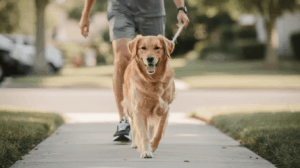
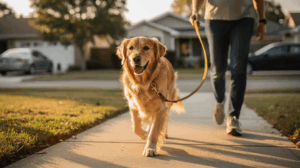
Loose-leash walking means the leash remains relaxed while you and your dog move together. The dog does not need to maintain a perfectly precise position, but it should not drag, pull, or keep the leash under constant tension.
A relaxed leash often forms a visible J shape between the handler and the dog.
The dog may be:
- Slightly ahead or behind the handler
- Walking on either side, depending on the training plan
- Looking around the environment
- Pausing for permitted sniffing
- Adjusting its pace without pulling
The exact position matters less than the absence of sustained tension and the handler’s ability to maintain control.
Loose-Leash Walking Versus Heel
Loose-leash walking and heel are related but different skills.
Loose-leash walking generally allows the dog some freedom to move, look around, and sniff while keeping tension off the leash. A formal heel uses more specific positioning and attention criteria determined by the activity, trainer, or working context.
Most pet owners do not need a dog to maintain competition-level precision throughout an ordinary walk. A practical goal is a dog that can move with the handler, respond to direction, and pass routine distractions without sustained pulling.
Why Adult Dogs Pull
Dogs pull for different reasons, and identifying the likely cause helps determine the training plan.
Pulling Has Worked Before
When a dog pulls and reaches a smell, person, animal, or destination, that outcome may reinforce the pulling. From the dog’s perspective, tension on the leash has successfully moved the walk forward.
Training changes that pattern by reinforcing a loose leash and preventing pulling from consistently producing the desired result.
The Environment Is Highly Rewarding
Outdoor environments contain scents, movement, animals, people, food, and unfamiliar sounds. These distractions may be more rewarding than anything the handler currently offers.
Begin training in an environment where your dog can still notice you and take reinforcement.
The Dog Has Not Learned an Alternative
Leash walking is not an automatic skill. Dogs need to learn where to walk, how to respond to tension, when they may sniff, and how to stay connected to the handler.
Excitement, Fear, or Frustration
Not every dog that pulls is simply trying to reach a smell. Some dogs surge, freeze, bark, or lunge because they are excited, afraid, frustrated, or uncomfortable.
Pulling associated with intense barking, growling, snapping, escape attempts, or an inability to disengage requires more than ordinary leash-skills practice.
Physical Discomfort
Pain can change a dog’s gait, pace, posture, and willingness to walk. Contact your veterinarian if leash behavior changes suddenly or appears alongside:
- Limping
- Stiffness
- Coughing
- Reluctance to move
- Difficulty rising
- Unusual fatigue
- Sensitivity around the neck, shoulders, or back
Medical concerns should be evaluated before they are treated solely as training problems.
Core Principles of Loose-Leash Training
Reinforce the Position You Want
Mark and reward the moments when your dog walks near you with slack in the leash. A marker may be a word such as “yes” or a clicker.
Deliver the reward near the position where you want the dog to walk. If treats repeatedly appear beside your leg, remaining close to that area becomes more valuable.
You can also reinforce voluntary check-ins. When your dog looks toward you without being called, mark and reward that attention.
Use Forward Movement as a Reward
For many dogs, continuing the walk is valuable. During structured practice, a loose leash makes forward movement possible. When the leash becomes tight, movement pauses.
Access to sniffing can also function as reinforcement. After several successful steps, release the dog to investigate an appropriate area.
Practice Consistently
Household members should use the same:
- Walking cue
- Reward position
- Response to leash tension
- Release cue
- Equipment setup
- Rules about greeting and sniffing
If pulling sometimes reaches the desired destination, the dog has a reason to continue trying it.
Adjust the Environment
Training in an overwhelming setting usually produces frustration. Begin somewhere quiet and add difficulty gradually.
The UC Davis School of Veterinary Medicine recommends beginning in a quiet area, rewarding the dog when it is not pulling, and gradually increasing the walking distance and level of distraction.
Choosing Leash-Walking Equipment
Equipment can improve safety and management, but no collar or harness teaches loose-leash walking by itself.
Flat Collar
A flat collar can hold identification tags and may be sufficient for a dog that already walks comfortably. It may provide limited control for a strong dog with an established pulling habit.
Avoid allowing a dog to maintain continuous pressure against the neck.
Martingale Collar
A properly fitted martingale collar is commonly used for dogs whose head shape allows them to back out of a standard collar. It should be fitted correctly and should not function as an unrestricted choke collar.
Harness
A well-fitted harness distributes pressure differently from a neck collar. Front-attachment or dual-clip harnesses may provide additional management for dogs that pull.
Check that the harness:
- Does not restrict shoulder movement
- Does not rub behind the front legs
- Allows normal breathing and chest expansion
- Cannot be backed out of
- Is adjusted according to the manufacturer’s instructions
Head Halter
A head halter may provide additional directional control for some dog-handler teams. It must be introduced gradually, and the handler should understand how to use it without sudden jerking or force.
Dogs should not be expected to accept a head halter immediately.
Leash
A non-retractable leash provides a predictable working length. The appropriate length depends on the environment, the dog’s size, and the handler’s skill.
A standard leash is generally easier to manage on sidewalks and in public areas. A longer line may be useful in an open, safe training space but requires careful handling.
PetMD’s leash-training guide also recommends considering the dog, equipment, method, and training location together rather than relying on one tool.
Step-by-Step Loose Leash Walking for Adult Dogs
Phase 1: Begin in a Quiet Area
Start indoors, in a secure yard, or in another low-distraction space.
- Put on the dog’s walking equipment calmly.
- Stand with enough slack in the leash for the dog to move comfortably.
- Mark and reward the dog for looking toward you.
- Take one or two steps.
- Mark and reward while the leash remains loose.
- Pause before the dog loses focus.
- Repeat in several brief sessions.
Keep the session short enough that the dog remains engaged. There is no required number of minutes or repetitions.
Phase 2: Teach What Leash Tension Means
Once the dog can take several steps with a loose leash:
- Begin walking at a calm pace.
- Mark and reward slack in the leash.
- If the leash becomes tight, stop moving.
- Wait for the dog to turn, step back, or otherwise create slack.
- Mark the loose leash and resume walking.
- Reward the dog near your preferred walking position.
Another option is to change direction calmly when the dog begins pulling. Avoid snapping the leash or dragging the dog.
The goal is to make the consequences predictable:
- Loose leash: movement and reinforcement continue.
- Tight leash: structured forward movement pauses or changes direction.
Phase 3: Move to a Quiet Outdoor Area
Choose a driveway, quiet street, or another low-traffic location.
Allow the dog time to observe and sniff before expecting sustained attention. Alternate short periods of structured walking with permitted sniff breaks.
If the dog cannot take food, respond to a familiar cue, or disengage from the surroundings, the environment may be too difficult. Increase the distance from distractions or return to an easier location.
Phase 4: Add Distance and Distractions
Add one form of difficulty at a time.
Possible distractions include:
- A person standing at a distance
- A slow-moving bicycle
- A parked vehicle
- A dog far across an open area
- Mild traffic
- An unfamiliar walking route
Do not decrease distance simply because the dog has noticed the distraction. Move closer only while the dog can continue responding and walking without escalating.
Phase 5: Generalize the Skill
Dogs do not automatically understand that the same rules apply everywhere.
Practice in different locations while temporarily lowering your expectations. A dog that can walk well in the yard may need frequent reinforcement on a new sidewalk.
Gradually practice:
- At different times of day
- On several neighborhood routes
- Near calm people
- Near manageable traffic
- Around mild environmental movement
- On appropriate park or trail routes
Using Sniffing as Part of Training
Sniffing is a normal part of a dog’s walk. Loose-leash training does not require the dog to stare at the handler or remain in a strict position for the entire outing.
You can distinguish between structured walking and exploration by using separate cues.
For example:
- “Let’s go” may mean walking with the handler.
- “Go sniff” may release the dog to explore within the available leash length.
The leash should remain safe and manageable during either activity.
Using sniffing as a reward can make the walking routine clearer. Several loose-leash steps may earn permission to investigate an appropriate tree, patch of grass, or scent.
Common Loose-Leash Walking Problems
The Dog Pulls Immediately After Leaving the House
Excitement often begins before the walk starts.
Practice:
- Calmly putting on equipment
- Pausing at the door
- Opening the door only as far as the dog can handle
- Reinforcing attention before moving outside
- Beginning with a short training segment near home
If the dog bursts through the doorway, reset the exercise rather than allowing the pulling to begin the walk.
The Dog Pulls Toward Smells
Do not try to eliminate sniffing completely. Instead, use access to the scent as reinforcement.
Wait for slack in the leash, mark the response, and then move toward the smell or release the dog to investigate it.
The Dog Lunges Toward People or Dogs
Increase distance immediately. Avoid forcing close passes or repeatedly asking for a sit while the dog is unable to disengage.
Work at a distance where the dog can:
- Notice the trigger
- Turn toward the handler
- Take reinforcement
- Move away without escalating
Barking, lunging, growling, snapping, or intense fixation may indicate reactivity, fear, frustration, or aggression rather than a basic leash-skills problem.
Off Leash K9 Training of Lehigh Valley offers reactivity and aggression training for behavior concerns that require a more individualized plan. No program can guarantee the elimination of aggression.
The Dog Walks Well at Home but Pulls Elsewhere
This is a generalization issue rather than proof that the dog has forgotten everything.
Reduce the difficulty by:
- Moving farther from distractions
- Increasing reinforcement temporarily
- Shortening the practice segment
- Returning to a familiar cue
- Practicing in a quieter portion of the location
The Dog Pulls Only With Certain Family Members
Compare how each person:
- Holds the leash
- Rewards the dog
- Responds to pulling
- Allows sniffing
- Approaches other dogs
- Begins and ends the walk
Agrees on one household plan so the dog receives consistent information.
A Newly Adopted Dog Is Afraid of the Leash
Do not begin with a full neighborhood walk.
Start by:
- Showing the leash and providing reinforcement.
- Touching the clip to the harness or collar.
- Clipping and immediately removing it.
- Allowing the dog to wear the equipment briefly indoors.
- Practicing a few steps in a secure space.
- Moving outside only when the dog is comfortable.
A lightweight leash may be allowed to drag during supervised indoor conditioning, but never leave a dragging leash on an unattended dog.
Reward-Based Training and Equipment Questions
The American Veterinary Society of Animal Behavior recommends reward-based training for dog training and behavior modification. Review AVSAB’s humane dog-training position for its current guidance.
Training methods and equipment vary among trainers and programs. Before enrolling, ask:
- What equipment may be used?
- How will it be introduced?
- What alternatives are available?
- How does the trainer respond when a dog shows stress?
- What owner instruction is included?
- What practice is expected at home?
- Are any results being guaranteed?
Owners should understand and be comfortable with the proposed training plan before proceeding.
Choosing Professional Training
Professional help may be appropriate when:
- The handler cannot control the dog safely
- Pulling has caused an injury
- The dog’s behavior changes suddenly
- The dog becomes fearful outdoors
- The dog lunges, growls, snaps, or redirects
- Household members cannot maintain a consistent plan
- Independent practice is not progressing
- Equipment fit or handling remains unclear
Off Leash K9 Training of Lehigh Valley offers dog obedience training that may include heel, loose-leash walking, foundational commands, and work around distractions.
Board & Train programs provide a more immersive format. Curriculum, equipment, owner instruction, and follow-up support vary by package and should be reviewed before enrollment.
Visit the Plans & Pricing page for current program details. This article does not quote prices because packages and inclusions may change.
Practicing Around the Lehigh Valley
City Sidewalks
Allentown and Bethlehem sidewalks may include pedestrians, traffic, dogs, bicycles, and limited space. Begin on a quieter block or at a less active time rather than starting in the busiest area.
Use parked vehicles, driveways, or side streets to create additional distance when appropriate and safe.
Neighborhood Routes
Residential areas in Emmaus, Northampton, and surrounding communities can provide useful practice, but distraction levels vary by street and time of day.
Choose routes with enough space to turn around or cross safely if you need distance.
Parks and Trails
Review posted leash requirements before visiting. Keep your dog on an appropriate leash and remain alert for wildlife, narrow paths, cyclists, and other dogs.
Avoid retractable leashes where they make distance and control difficult to manage.
Frequently Asked Questions About Loose Leash Walking for Adult Dogs
Can an adult dog learn to stop pulling?
Adult dogs can learn new leash skills. The training timeline depends on the dog’s pulling history, physical health, environment, motivation, and the owner’s consistency.
How long does loose-leash training take?
There is no universal timeline. Some dogs show early improvement quickly, while reliable walking around distractions may take considerably longer. Judge progress by behavior rather than a fixed number of days or weeks.
Should I stop every time my dog pulls?
Stopping when the leash tightens is one commonly used technique. It works best when paired with reinforcement for the position you want. In situations where stopping is unsafe, or the dog is escalating, create distance and prioritize safety.
Is a harness better than a collar?
It depends on the dog, fit, behavior, and handler. A well-fitted harness may help manage pulling and avoid continuous neck pressure, but it does not replace training.
Should my dog walk beside me for the entire walk?
Not necessarily. Many dogs benefit from both structured walking and opportunities to sniff. Separate cues can clarify when the dog should remain closer and when exploration is allowed.
What if my dog will not take treats outside?
The environment may be too distracting or stressful, or the reward may not be valuable enough. Move to a quieter area and try again. A sudden loss of appetite or other physical symptoms should be discussed with a veterinarian.
Is pulling the same as leash reactivity?
No. A dog may pull simply because it wants to move faster or reach something. Reactivity involves a stronger emotional response and may include barking, lunging, growling, freezing, or an inability to disengage.
When should I contact a professional?
Seek help when you cannot manage the dog safely, pulling is causing injury, behavior changes suddenly, or the dog displays fear, aggression, or intense reactivity. You do not need to wait for a specific number of weeks when safety is involved.
Conclusion
Loose-leash walking is not limited to dogs that began training as puppies. Adult dogs can learn new leash skills through clear criteria, appropriate equipment, reinforcement, and gradual practice.
Start by:
- Checking that your dog’s equipment fits properly.
- Practicing in a quiet environment.
- Reinforcing attention and slack in the leash.
- Pausing or changing direction when pulling begins.
- Using appropriate sniffing opportunities as rewards.
- Adding distractions gradually.
- Keeping household rules consistent.
- Seeking professional help when behavior or safety concerns go beyond ordinary pulling.
If you want help selecting an appropriate training option, use the contact page to request a free phone consultation with Off Leash K9 Training of Lehigh Valley.