
Our Dog Training Philosophy: Building Better Dogs, Not Just Better Obedience
There is a major difference between a dog that knows obedience commands and a dog that has actually been developed into a better dog.
A dog can know Sit, Down, Place, Heel, and Come and still be insecure, reactive, disengaged from its owner, environmentally overwhelmed, or incapable of making good decisions without constantly being told what to do.
That is why our philosophy at Off Leash K9 Training goes far beyond teaching commands.
Our goal is to develop confident, fulfilled, clear-headed dogs that understand how to make good decisions—and owners who understand how to communicate with them.
Obedience is an important part of that process, but it is only one part.
Great dog training should improve the relationship between dog and owner. It should create clarity and accountability. It should build confidence. It should provide appropriate outlets for the dog’s natural drives and instincts. And ultimately, it should give dogs more freedom, not less.
We Train the Dog in Front of Us
One of the biggest mistakes in dog training is treating every dog as though they’re the same.
They’re not.
Dogs come to us with different genetics, temperaments, drives, experiences, confidence levels, environmental sensitivities, motivations, and behavioral histories.
A Belgian Malinois bred for working ability is not the same dog as a companion-bred Golden Retriever. A genetically confident dog is different from an environmentally insecure dog. A dog displaying aggression because of fear may require a completely different approach than a confident dog displaying aggressive behavior for another reason.
Good training starts by understanding why the dog is doing what it’s doing.
Instead of immediately asking, “How do I stop this behavior?” we often need to ask:
“Why is this behavior happening in the first place?”
That distinction becomes especially important when dealing with fear, anxiety, reactivity, and aggression.
Training should never be nothing more than applying a predetermined formula to every dog.
We have principles that guide our training, but the application of those principles has to fit the individual dog.
Play Is One of the Foundations of Our Training
One of the most important—and most overlooked—parts of our training philosophy is play.
Not simply throwing a ball across the backyard while looking at your phone.
We’re talking about intentional, structured, interactive play between the dog and the human.
Play is one of the most powerful tools available to us because it can simultaneously develop engagement, confidence, communication, motivation, trust, cooperation, and relationship.
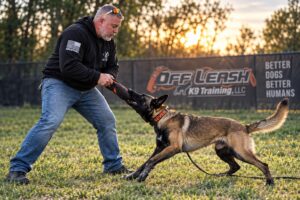
We commonly use two primary forms of structured play: tug and fetch.
Tug is competitive.
Fetch is cooperative.
Both can teach incredibly valuable lessons when they’re structured correctly.
During play, the dog learns that interacting with you is exciting and rewarding. They learn rules and boundaries. They learn when the game begins, when it ends, how to release an object, how to re-engage, and how to manage increasingly high levels of excitement while still remaining responsive to the handler.
Most importantly, we’re giving the dog an appropriate outlet for behaviors that already exist naturally.
Dogs want to chase.
They want to bite.
They want to possess.
They want to run.
They want to hunt, pursue, grab, carry, pull, and interact with the environment.
Instead of constantly telling dogs not to be dogs, we believe in giving those drives appropriate outlets.
We’ve written extensively about this in our article Why You Should Play With Your Dog, including how we structure play and why it can completely change the relationship between a dog and its owner.
Read: Why You Should Play With Your Dog
Play isn’t something we do after the “real training” is finished.
Play is training.
Relationship Before Micromanagement
We want our dogs to value us.
That doesn’t mean the dog needs to stare at us every second of the day or constantly wait for another command.
In fact, we want almost the opposite.
We want to develop dogs capable of functioning independently while still maintaining a strong relationship and communication system with their owner.
Think about the difference between constantly controlling a dog and actually developing one.
If I have to tell my dog:
Heel.
Leave it.
Heel.
No.
Watch me.
Leave it.
Heel.
Every few seconds just to walk past another dog, I may technically have control—but I haven’t necessarily created a dog capable of making good decisions.
There are certainly situations where obedience and management are necessary. But our long-term goal is not perpetual micromanagement.
We want the dog to eventually understand:
“I’ve seen that before. I know what it is. I know what is expected of me. I don’t need to react to it.”
That’s a very different dog.
Obedience Is a Language, Not the Finished Product
We absolutely teach obedience.
Come.
Sit.
Down.
Place.
Heel.
Recall.
Impulse control.
Boundary behaviors.
Advanced obedience and off-leash reliability.
These skills matter tremendously.
But we don’t view obedience as a collection of tricks.
Obedience creates a common language between you and your dog.
If you and your dog don’t have a shared communication system, it becomes very difficult to navigate complicated situations.
A reliable Place command can allow your dog to calmly exist while guests enter the house.
A reliable recall can give your dog tremendous off-leash freedom.
A reliable Heel can help you safely navigate busy environments.
A Down can allow the dog to settle somewhere instead of constantly being physically managed.
Commands create clarity.
But once that language exists, we want to use it to help develop the dog—not simply spend the rest of the dog’s life issuing commands every thirty seconds.
Clarity Is Kind
Dogs thrive when the rules of their world make sense.
They should understand which behaviors create reinforcement and which behaviors have consequences.
Unfortunately, humans frequently make this unnecessarily confusing.
We allow something Monday.
Correct it Tuesday.
Laugh about it Wednesday.
And become angry about it Thursday.
Then we wonder why the dog doesn’t understand the rule.
Training should create clarity and consistency.
We spend a tremendous amount of time teaching dogs what we want and reinforcing those behaviors.
Food can be reinforcement.
Play can be reinforcement.
Freedom can be reinforcement.
Access to the environment can be reinforcement.
Praise and affection can be reinforcement.
But we also believe consequences have a legitimate place in dog training.
Reinforcement and Accountability Can Exist Together
Our philosophy is balanced.
That means we’re comfortable using reinforcement to strengthen good behavior and appropriate consequences to discourage unacceptable behavior.
Those two concepts aren’t contradictory.
They’re part of communication.
Before correcting a dog for failing to follow a command, we first need to make sure the dog actually understands the command.
There is an enormous difference between a dog that doesn’t understand what you’re asking and a dog that clearly understands but chooses something else.
Teaching comes first.
Clarity comes first.
Then accountability becomes possible.
When a dog understands the expectation, we believe fair and appropriately applied consequences for poor decisions can be valuable information.
The purpose isn’t anger.
It isn’t intimidation.
It isn’t winning a confrontation with the dog.
The purpose is communication.
Good choices should have desirable consequences. Poor choices can have undesirable consequences.
That is how animals—including humans—learn about the world around them.
We Want Dogs That Think
One of our ultimate goals is to create a free-thinking dog.
That can sound strange coming from professional dog trainers.
Shouldn’t the dog just obey?
Sometimes, absolutely.
If I call my dog away from a road, I don’t want a committee meeting.
Recall means come.
But everyday life contains thousands of situations where I would rather have a dog capable of making an appropriate decision without waiting for me to tell them exactly what to do.
Imagine a dog notices another dog across the park.
Instead of immediately exploding at the end of the leash—or requiring the owner to issue five commands—the dog notices it and decides:
“That’s irrelevant.”
That decision is incredibly valuable.
The same applies to ignoring food on the ground, settling appropriately in public, moving through crowds, encountering strange objects, interacting appropriately with people, or choosing to remain near the owner when given freedom.
We want dogs to understand boundaries well enough that eventually the boundary itself influences the decision.
That is development—not simply obedience.
Behavior Modification Has to Go Deeper Than Suppressing the Reaction
This philosophy becomes especially important when we’re working with reactive or aggressive dogs.
Imagine a dog sees another dog 50 feet away and explodes.
Barking.
Lunging.
Growling.
Pulling.
One solution might be putting that dog into a strict Heel and correcting every attempt to break position.
Eventually, we might create a dog that walks beside us without displaying the outward behavior.
That can absolutely be useful.
But we need to ask a more important question:
What does the dog think about the other dog now?
If the dog’s internal perception is still:
“That dog is dangerous.”
“That dog makes me uncomfortable.”
“I need to defend myself.”
“I need to make that dog go away.”
Then we’ve potentially controlled the symptom without fully addressing the underlying problem.
That’s why we frequently talk about changing perception rather than simply suppressing reaction.
We want to understand why the dog is reacting and then work on changing the dog’s relationship with that trigger.
That may involve building confidence.
Creating appropriate exposure.
Changing associations.
Using play.
Developing engagement.
Establishing clearer leadership and boundaries.
Teaching obedience.
Using distance appropriately.
Giving the dog successful experiences.
And yes, when appropriate, creating accountability for poor behavioral decisions.
There is rarely one magic technique.
Behavior modification is about developing the entire dog.
Confidence Cannot Simply Be Commanded
You can’t tell an insecure dog:
“Be confident.”
Confidence has to be developed through experience.
Dogs become more confident by successfully navigating challenges.
That doesn’t mean overwhelming them or throwing them into situations they’re incapable of handling.
It means finding appropriate challenges and helping the dog work through them.
New surfaces.
New environments.
Unusual objects.
Appropriate social experiences.
Structured play.
Problem solving.
Physical challenges.
Environmental exploration.
Controlled freedom.
Every successful experience becomes another deposit into that dog’s confidence account.
Over time, the dog begins approaching unfamiliar situations differently.
Instead of immediately thinking:
“I can’t handle this.”
The dog begins learning:
“I’ve handled difficult things before. I can figure this out.”
That mindset matters tremendously.
Biological Fulfillment Matters
Modern dogs live incredibly unnatural lives.
Many spend most of their day inside a house or kennel.
Then we take an animal selectively bred for generations to chase, hunt, retrieve, herd, guard, bite, run, track, or work alongside humans—and wonder why a twenty-minute leash walk around the neighborhood isn’t enough.
Physical exercise matters, but biological fulfillment is more than simply making a dog tired.
A fulfilled dog gets opportunities to perform behaviors that satisfy natural drives.
For one dog, that may mean tug.
For another, retrieving.
For another, tracking and using its nose.
It may mean running through the woods, swimming, exploring, climbing, problem solving, carrying something, searching for something, or simply being allowed to experience the environment.
We don’t want to remove everything that makes dogs dogs.
We want to channel those behaviors productively.
And when we fulfill dogs appropriately, we often find that many undesirable behaviors become easier to address because we’re no longer fighting against the dog’s biology every waking hour.
Training Should Ultimately Create More Freedom
This may be the biggest principle behind everything we do.
The purpose of control should eventually be freedom.
We teach recall so dogs can safely experience off-leash freedom where appropriate.
We teach boundaries so dogs can participate in more of our lives.
We teach impulse control so dogs don’t need to be isolated whenever something exciting happens.
We build confidence so dogs can explore new environments.
We develop engagement so owners can take their dogs places without competing against the entire world for their attention.
We create accountability because dogs that understand boundaries can often safely receive privileges that unreliable dogs cannot.
The goal isn’t to spend a dog’s entire life tightening the leash.
The goal is to eventually loosen it.
Freedom is earned through reliability.
Tools Are Just Tools
Dog training discussions often become obsessed with equipment.
Food.
Toys.
Flat collars.
Slip leads.
Prong collars.
Long lines.
E-collars.
People sometimes become so focused on the tool that they stop discussing the training.
We don’t believe a tool defines a training philosophy.
How, why, and when a tool is used matters far more than simply whether it is used.
An e-collar doesn’t train a dog.
A prong collar doesn’t train a dog.
Food doesn’t train a dog.
A tug doesn’t train a dog.
A leash doesn’t train a dog.
A knowledgeable human uses those tools to communicate, reinforce behavior, create accountability, and develop the dog.
Tools should be selected based on the dog, the behavior, the training objective, and the owner’s ability to use them properly.
The Owner Is Part of the Training
We can teach your dog.
But ultimately, you have to live with your dog.
That’s why owner education is such an important part of what we do.
We want owners to understand not just what to do, but why they’re doing it.
Why did the dog make that decision?
Why are we reinforcing this?
Why are we correcting that?
Why are we adding distance here?
Why are we playing now?
Why did the dog become uncomfortable?
Why did that interaction succeed?
Why did this one fail?
Once owners begin understanding those principles, they stop depending entirely on a trainer.
They begin learning to read their own dog.
And that changes everything.
Better Dogs. Better Humans.
At the end of the day, we’re not trying to create robots.
We’re trying to develop dogs.
Dogs that enjoy working with their owners.
Dogs that understand boundaries.
Dogs that have appropriate outlets for their drives.
Dogs that can confidently navigate the world.
Dogs that understand how to make good decisions.
Dogs that can be held accountable when they knowingly make poor ones.
Dogs that can play hard, work hard, relax, explore, and simply be dogs.
And owners who understand them.
Our philosophy can ultimately be summarized by a handful of principles:
Relationship. Communication. Clarity. Confidence. Accountability. Biological Fulfillment. Freedom.
Commands matter.
Tools matter.
Technique matters.
But none of those things, by themselves, represent the finished product.
Because we don’t believe the best-trained dog is simply the dog that knows the most commands.
We believe it’s the dog that can successfully navigate life with you.
And if we’ve done our job correctly, training shouldn’t make your dog’s world smaller.
It should make their world bigger.
Author: Evan Carson, President and Trainer, Off Leash K9 Training, Lehigh Valley, Scranton and Salt Lake City, Utah
