
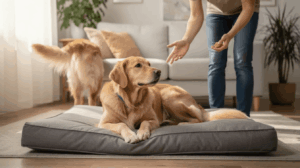
Learning how to teach the place command gives your dog a clear destination during everyday situations such as answering the door, preparing food, or welcoming visitors. The cue directs your dog to a defined surface and asks them to remain within that boundary until released.
This guide explains how to introduce the surface, add the cue and release word, and gradually build duration, distance, and distractions. You will also learn how to troubleshoot common problems without rushing your dog or turning the Place surface into a punishment.
Off Leash K9 Training of Lehigh Valley includes the Place command in several obedience programs, but you can begin teaching the basic behavior at home with a suitable surface, small rewards, and short training sessions.
What Does the Place Command Mean?
Place usually means:
- Go to a designated cot, mat, or bed.
- Step fully onto the surface.
- Remain within its boundary.
- Wait for a release cue before leaving.
Your exact criteria should remain consistent. Some owners allow the dog to sit, stand, turn around, or lie down as long as all four paws remain on the surface. Others add a separate Down cue once the dog arrives.
Place differs from Stay because it gives the dog a destination. Stay generally asks the dog to remain where they are, sometimes in a particular posture. Exact definitions vary between training systems, so clarity and consistency matter more than the word itself.
Place can be useful during:
- Meal preparation
- Family meals
- Supervised visitor arrivals
- Household cleaning
- Video calls
- Calm evening routines
- Training in new environments with a portable mat
Place is a trained behavior, not a treatment for fear, anxiety, aggression, or reactivity. Dogs showing significant distress or potentially dangerous behavior need an individualized management and training plan.
What You Need Before You Start
Gather the following items before your first session:
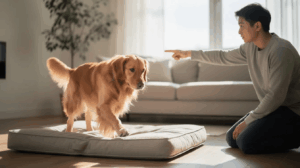
- A raised cot, non-slip mat, or supportive dog bed
- Small, appealing food rewards
- A clicker or verbal marker such as “yes”
- A release word such as “free” or “break”
- A standard leash, if needed for safe guidance
- A quiet training area with limited distractions
Choose a Clearly Defined Surface
Your dog should be able to see and feel where the surface begins and ends.
A raised cot offers a particularly clear boundary, but a stable mat or bed can also work. Select a surface large enough for your dog to stand, turn around, and lie down comfortably. Make sure it does not slide, wobble, or tip when your dog steps onto it.
A crate is a separate management and rest tool rather than the best surface for introducing Place. Begin with an open cot, mat, or bed so the boundary behavior is easy to observe.
Select a Marker and Release Cue
A marker identifies the exact behavior that earned the reward. You can use a clicker or a short word such as “yes.”
The release cue tells your dog that the exercise has ended. Choose one word and use it consistently. Avoid relying on casual phrases that your dog hears throughout the day.
A previous Sit or Down cue can be helpful, but neither is required to begin Place. Start by rewarding your dog for stepping fully onto the surface.
How to Teach the Place Command Step by Step
Keep early sessions short and finish while your dog is still engaged. Several successful repetitions are more useful than continuing until your dog becomes tired, distracted, or frustrated.
Step 1: Introduce the Surface
Place the cot or mat in a quiet room. Allow your dog to look at or investigate it without pressure.
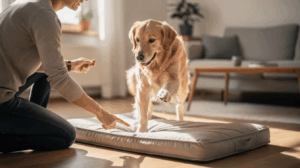
You can toss a treat onto the surface or use food in your hand to guide your dog toward it. Mark and reward any useful interaction, including looking at the surface, approaching it, or placing a paw on it.
If your dog appears worried, do not pull or force them onto the surface. Check that it is stable and reward smaller steps until your dog is comfortable.
Step 2: Reward All Four Paws on the Surface
Guide your dog onto the surface. The moment all four paws are on it, mark the behavior and deliver the reward while your dog is still there.
Rewarding on the surface matters. If you call your dog back to you before delivering the treat, you may accidentally reinforce leaving rather than remaining on Place.
This progressive approach is also described in the American Kennel Club’s guide to teaching a dog to go to Place, which begins by rewarding interaction with the mat and gradually requiring all four paws.
Repeat until your dog begins stepping onto the surface readily.
Step 3: Introduce the Release Cue
Do not wait for your dog to step off independently. After a brief moment on the surface, say your release word and encourage your dog to leave.
Reset and repeat:
- Guide your dog onto the surface.
- Mark and reward.
- Pause briefly.
- Give the release cue.
- Begin the next repetition.
Teaching the release early helps your dog understand that remaining on the surface is part of the behavior.
Step 4: Add the Word “Place”
Add the verbal cue after your dog is predictably moving toward the surface.
Say “Place” just before your dog steps onto it. Mark and reward when all four paws are on the surface, then use the release word to end the repetition.
Avoid repeating the cue several times. If your dog does not respond, make the exercise easier by moving closer, pointing to the surface, or temporarily returning to a food lure.
Step 5: Encourage a Comfortable Position
Once your dog understands the boundary, you may ask for Sit or Down on the surface. You can also reward your dog for choosing to lie down voluntarily.
Do not assume that remaining on Place automatically means your dog is relaxed. A dog may be physically still while showing signs of stress, such as panting when not hot, trembling, repeatedly scanning the room, refusing food, or trying to escape.
If those signs appear, reduce the difficulty or end the session.
Step 6: Build Duration Gradually
Begin with a duration your dog can complete easily. Return to the surface, mark, and reward while your dog remains there.
Increase the interval in small steps. Mix easier repetitions into the session instead of making every repetition longer than the last.
If your dog steps off repeatedly:
- Shorten the duration.
- Increase the reward frequency.
- Reduce nearby activity.
- Check whether your dog needs a bathroom or movement break.
- End the session before frustration builds.
There is no universal duration target. The appropriate goal depends on your dog’s age, comfort, training history, and how you plan to use the behavior.
Step 7: Add Distance
When your dog can remain on the surface while you stand nearby, begin moving away.
Start with one small step. Immediately return, reward your dog on the surface, and release when appropriate. Gradually progress to:
- Taking several steps away
- Sitting in a nearby chair
- Walking across the room
- Briefly turning your back
- Moving around the room
- Stepping out of sight for a moment
If distance causes your dog to leave, move closer again. Duration practiced beside your dog does not automatically transfer to distance.
Step 8: Introduce Distractions
Add mild distractions only after your dog understands the cue, boundary, and release word.
Possible starting distractions include:
- Setting an object on a table
- Opening a cabinet
- Sitting down and standing up
- Walking past the mat
- Turning on the television at low volume
Later, you can practice around more activity, such as meal preparation or a family member entering the room.
Do not begin with your dog’s most difficult trigger. Increase only one variable at a time: duration, distance, or distraction.
Step 9: Practice in New Locations
Dogs do not always apply a learned behavior automatically in a new room or on a different surface.
When you move the cot or introduce a travel mat, temporarily lower your expectations. Practice a few easy repetitions with frequent rewards before rebuilding duration and distractions.
This helps your dog understand that Place can apply to different designated surfaces rather than only one bed in one room.
Common Place-Training Mistakes
Adding the Cue Too Early
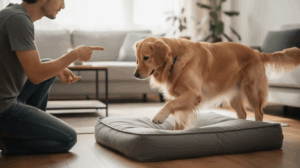
If you repeatedly say “Place” before your dog understands the movement, the word can become background noise. Establish the behavior first, then add the cue as your dog starts moving toward the surface.
Increasing Difficulty Too Quickly
A dog that can remain on Place in a silent room may not be ready to hold it while visitors enter. Build a reliable foundation before adding major distractions.
Changing Several Variables at Once
Avoid increasing duration, walking farther away, and adding a doorbell in the same repetition. Change one variable while keeping the others easy.
Rewarding After the Dog Leaves
Deliver rewards while your dog is on the surface. Use the release cue before inviting your dog off.
Using Place as Punishment
Avoid angrily sending your dog to Place after unwanted behavior. The surface should remain a predictable training station rather than something your dog learns to fear or avoid.
The American Veterinary Society of Animal Behavior’s humane dog-training guidance recommends reward-based training methods for dog training and behavior modification.
Expecting Relaxation on Cue
Place establishes a physical boundary. Relaxation is a separate emotional state and cannot be forced. Keep the session within your dog’s ability and watch for signs of discomfort.
Troubleshooting Common Problems
My Dog Will Not Step on the Surface
Check whether the cot wobbles, the mat slides, or the texture is uncomfortable. Try a stable, nonslip surface and reward one paw, then two paws, before requiring all four.
Higher-value food may help, but do not use food to pressure a frightened dog closer than they are willing to go.
My Dog Steps Off Immediately
Your dog may understand how to get onto the surface without understanding that remaining there is part of the cue.
Return to very short repetitions. Reward your dog on the surface and release before they choose to leave. Gradually delay the release once the pattern is clear.
My Dog Breaks When I Walk Away
Reduce the distance. Practice shifting your weight, taking half a step, or taking one complete step before returning to reward your dog.
Build distance gradually instead of testing how far you can go.
My Dog Whines, Barks, or Paces
First check whether your dog needs a bathroom break, movement, water, or relief from an overwhelming environment.
Make the exercise easier and reward brief moments of comfortable, quiet behavior. End the session if your dog continues to show distress rather than requiring them to remain on the surface.
Persistent distress may indicate that the problem is broader than Place training.
My Dog Runs to Place but Will Not Settle
Your dog may have learned that reaching the surface earns rapid rewards, creating excitement rather than calm behavior.
Slow the reward delivery slightly, reinforce comfortable body positions, and practice after appropriate exercise and a bathroom break. Keep the environment quiet while building duration.
Place Compared With Other Management Tools
| Tool or cue | Main purpose | Physical boundary | Requires training? |
| Place | Sends the dog to a designated surface until released | Yes | Yes |
| Stay | Asks the dog to remain where they are | No | Yes |
| Crate | Provides physical confinement and management | Yes | Crate comfort should be trained |
| Gate | Restricts access to part of the environment | Yes | No |
| Tether | Limits movement within a supervised area | Yes | No |
These options are not interchangeable. Place and Stay are trained behaviors. Crates, gates, and tethers physically manage access and may be important when a trained cue is not reliable enough for the situation.
Never use Place as the only safety measure when a dog presents a bite risk, may escape through an exterior door, or cannot safely interact with a visitor.
Using Place in Everyday Situations
Once your dog has practiced the behavior successfully, you can begin incorporating it into predictable routines.
During Meals
Send your dog to Place before food is served. Begin with a short portion of the meal and gradually build duration rather than expecting your dog to remain there throughout dinner immediately.
When Visitors Arrive
Practice first with a household member or familiar helper. Use a gate, leash, closed door, or another physical management measure whenever necessary.
Place should not substitute for a safety plan when a dog is fearful, aggressive, or likely to rush through the door.
During Household Activities
Place can give your dog a clear station while you cook, clean, carry groceries, or complete other tasks. Continue supervising your dog and provide appropriate breaks.
Away From Home
A portable mat can help transfer the cue to training classes, a friend’s home, or another suitable environment. Begin with easy repetitions because new surroundings add difficulty.
When Professional Training May Help
Professional support may be useful if:
- Your dog remains frightened of the surface.
- Your dog cannot engage around ordinary household distractions.
- Attempts to guide your dog cause growling, snapping, or avoidance.
- You need help introducing the cue around visitors.
- Your dog has a history of aggression, reactivity, or biting.
- You are unsure how to adjust the training plan safely.
Dogs showing significant fear, aggression, reactivity, or a bite risk may require specialized behavioral support. In addition to speaking with your veterinarian, owners can use the IAABC consultant directory to search for a credentialed animal behavior professional.
Off Leash K9 Training offers dog obedience training in Lehigh Valley through private lessons and Board & Train options. Place is included in several available programs, depending on the selected package.
Review current program information on the Plans & Pricing page, or use the contact page to request a free phone consultation.
Frequently Asked Questions About the Place Command
How long does it take to teach the Place command?
There is no dependable universal timeline. Some dogs learn to step onto the surface within a few sessions but need substantially more practice before remaining there at a distance or with distractions.
Progress depends on the dog, the environment, training history, reward value, session length, and the criteria being taught.
How long should a dog remain on Place?
Start with a duration your dog can complete comfortably. Increase it gradually according to the situation in which you plan to use the cue.
Longer is not automatically better. Dogs need bathroom, water, movement, social, and rest breaks appropriate to their individual needs.
Can a puppy learn Place?
Yes. Puppies can learn to step onto a mat or cot and wait briefly before being released. Keep sessions short, use age-appropriate expectations, and do not require prolonged stationary behavior.
Does my dog need to know Down first?
No. Down can be added later, but the initial Place behavior only requires your dog to move onto a defined surface and remain within its boundary until released.
Can I use more than one Place surface?
Yes. Introduce each new surface with several easy repetitions. Dogs may need help understanding that the same cue applies to a different mat, bed, cot, or location.
Can Place fix aggression or reactivity?
No. Place may be one component of a broader management plan, but it does not treat the underlying cause of fear, aggression, or reactivity.
Seek individualized professional help, particularly when your dog has threatened, snapped at, or bitten a person or animal.
Do I need an e-collar to teach Place?
No. An e-collar is not required to teach the Place cue. The behavior can be introduced with a stable surface, rewards, a marker, a release cue, and gradual practice.
This article does not provide instructions for applying an e-collar. Owners considering training equipment should discuss the methods, risks, and alternatives with an appropriately qualified professional.