Dog training hand signals are distinct gestures used to cue behaviors such as sit, down, stay, come, and heel. Dogs pay close attention to human movement and body language, making visual cues a useful addition to verbal cues.
Hand signals can help in noisy environments, give you another way to communicate at a distance, and provide an important option for dogs experiencing hearing loss. They can also make handlers more aware of their own timing, posture, and consistency.
This guide explains how to introduce dog training hand signals at home, practice them around gradually increasing distractions, and use them more reliably in everyday situations. You will learn:
- Why visual cues can be useful
- Which signals to teach first
- How to transfer a behavior from a verbal cue to a gesture
- How to build distance, duration, and distraction
- How to correct common training problems
- When to seek professional assistance
If you need individualized guidance, Off Leash K9 Training of Lehigh Valley offers private lessons and immersive training options for dogs with different ages, temperaments, and training histories.
Understanding Dog Training Hand Signals
A hand signal is a visual cue assigned to a particular behavior. For example, an upward hand movement might tell your dog to sit, while an open palm might mean stay.
Hand signals can supplement spoken cues or eventually function on their own. They are especially useful when:
- The environment is too noisy for a spoken cue to carry clearly
- You need to communicate without raising your voice
- Your dog is working at a distance but can still see you
- Your dog has partial or complete hearing loss
- You want another way to check whether your dog understands a behavior
Research discussed by the American Kennel Club suggests that visual information can play an important role in how dogs locate and respond to people. The practical lesson is simple: what your body is doing may matter as much as—or more than—what you are saying.
A visual cue works only when the dog can see it. Before giving a signal, make sure your dog is looking in your direction. If the dog is sniffing, watching another animal, or facing away, repeating the gesture will not make it clearer.
Are Dog Hand Signals Standardized?
There is no single required set of hand signals for pet dogs. You can use conventional training gestures, adapted signs, or another movement that is easy for you to perform and your dog to distinguish.
What matters most is that each signal is:
- Visibly different from your other cues
- Easy for you to repeat
- Appropriate for the distance at which you will use it
- Used consistently by everyone handling the dog
- Comfortable for the dog to observe
VCA Animal Hospitals’ guidance on training deaf dogs similarly explains that owners may use established gestures, modified signs, or signals they create themselves. Each behavior simply needs a clear, distinct cue.
Benefits of Teaching Hand Signals
Clearer Communication
Visual cues encourage handlers to make each request intentional. Instead of repeating a word several times, you present one clear signal and allow the dog to respond.
Another Option in Noisy Settings
Traffic, wind, crowds, and other environmental noise can make spoken cues harder to hear. A trained visual cue provides another communication channel when your dog is looking at you.
Support for Dogs With Hearing Loss
Dogs with hearing loss can learn many of the same behaviors as hearing dogs through visual and, where appropriate, tactile cues. Teaching visual cues before hearing declines can also make a later transition easier.
Deaf dogs require additional safety precautions. They should not be allowed off leash in open, unfenced areas simply because they understand hand signals. A secure enclosure or properly handled long line is the safer option.
Better Handler Awareness
Dogs notice subtle movements. Leaning, shifting weight, reaching toward a treat pouch, or turning a shoulder can unintentionally become part of a cue.
Training with deliberate hand signals helps you notice whether your dog is responding to the intended gesture or to an accidental movement.
Common Dog Training Hand Signals
The following gestures are practical examples, not mandatory standards. You may choose different signals as long as they remain distinct and consistent.
| Command | Example gesture | Important detail |
| Sit | Open palm moving upward from your side | Use a smooth, repeatable motion |
| Down | Palm facing the floor and moving downward | Avoid bending over the dog |
| Stay | Open palm facing the dog | Pair it with a clear release cue |
| Wait | A distinct gesture chosen by your household | Keep it different from stay |
| Come | Arm extended and sweeping inward toward your body | Make the movement visible at a distance |
| Heel | Tap or point to the side where the dog should walk | Use the same walking side consistently |
| Focus | Point toward your eyes or face | Reinforce the dog for looking at you |
| Place | Point toward the designated mat, bed, or cot | Teach the destination at close range first |
| Drop it | Use a distinct open-hand gesture | Reinforce releasing the object |
| Free or release | Sweep an open hand away from the dog | Use it consistently to end stationary behaviors |
Sit Hand Signal
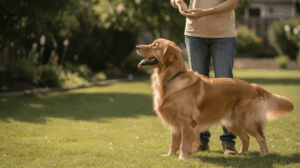
A common sit signal begins with your hand near your side, palm facing upward. Move your hand smoothly toward chest or shoulder height.
This motion often develops naturally from using a treat near the dog’s nose and moving it slightly upward and back. As the dog follows the treat with its eyes, the rear may lower into a sit.
Use the signal when you want your dog to sit before a doorway, during a greeting, or before moving into a busier setting. Do not rely on the sit alone to keep a dog safe near traffic; continue using an appropriate leash.
Down Hand Signal
A common down signal uses an open hand or palm moving toward the floor. Begin teaching it close to the dog in a quiet setting.
The dog should follow the cue willingly rather than being physically pushed into position. If the dog struggles, return to an easier step and reinforce movement toward the floor.
Down can support longer-duration behaviors such as stay or settling on a mat. It can give the dog a clear task, but it should not be treated as a substitute for addressing fear, anxiety, or excessive arousal.
Stay and Wait Hand Signals
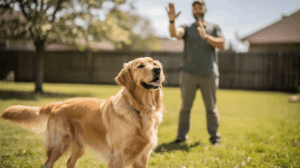
An open palm facing the dog is commonly used for stay. Begin with a very short duration and remain close to the dog. Reward before the dog gets up, then use a clear release cue.
Increase difficulty gradually:
- Add a small amount of duration.
- Take one step away.
- Return and reinforce the dog.
- Add distance in small increments.
- Introduce mild distractions only after the dog understands the exercise.
Some owners use “stay” and “wait” differently. Stay may mean remaining in one position until released, while wait may mean pausing temporarily at a doorway or food bowl. If you use both, assign a distinct gesture to each.
Come or Recall Hand Signal
A visible recall signal can begin with one arm extended away from your body and then sweeping inward toward your chest.
Start close to your dog in a low-distraction area. Present the signal once, encourage the dog to move toward you, and reinforce generously when the dog arrives.
Practice recall with a leash or long line until your dog has a strong reinforcement history and can respond around controlled distractions. Do not test an unfinished recall in an unfenced area. A hand signal cannot help if the dog is facing away or unable to see you.
Heel and Focus Signals
A tap or point near your hip can cue the dog to move to the walking side you have selected. Begin from a stationary position before asking the dog to maintain that position while walking.
A focus cue can be taught by pointing toward your eyes or face. Reinforce the dog for making eye contact or orienting toward you.
These cues can make walks more organized, but they should be practiced away from overwhelming triggers before being used in difficult environments.
Place Signal
A place signal directs the dog toward a defined mat, bed, platform, or cot. Point toward the destination from a short distance and reinforce the dog for stepping onto it.
Build the behavior in stages:
- Reinforce looking at or approaching the mat.
- Reinforce placing paws on it.
- Reinforce moving fully onto it.
- Add the chosen hand signal.
- Introduce duration.
- Add distance and distractions gradually.
Place can be useful when guests arrive, during meals, or when the dog needs a predictable location to settle.
How Dogs Learn Visual Cues
A dog learns a hand signal by repeatedly seeing the gesture before performing a behavior that earns reinforcement. With clear timing and consistent practice, the gesture becomes a cue that tells the dog which behavior can earn a reward.
There are two common starting points.
Starting With a New Behavior
If the dog does not yet know the behavior, use a lure, shaping, or another reward-based teaching technique to help the dog perform it. The movement used to guide the dog may gradually become the finished hand signal.
Adding a Hand Signal to a Known Verbal Cue
If the dog already responds to a spoken cue:
- Make sure the dog is watching you.
- Present the new hand signal.
- Pause briefly.
- Give the familiar verbal cue.
- Mark and reward the behavior.
- Repeat in short sessions.
- Gradually delay and remove the verbal cue as the dog begins responding to the gesture.
The order matters. If you say the familiar word first, the dog may respond before noticing the new signal.
How to Teach a New Hand Signal
1. Choose One Clear Gesture
Select a movement that is easy to repeat and does not resemble your other signals. Write it down so other household members can use the same cue.
2. Begin in a Quiet Setting
Start in a familiar room with minimal distractions. Your dog should be able to look at you, take reinforcement, and participate comfortably.
3. Prompt the Behavior
Use a food lure, an existing verbal cue, or another appropriate prompt to help your dog perform the behavior.
4. Mark and Reinforce
The moment the dog completes the correct behavior, use a marker such as “yes” or a clicker and deliver a reward.
For a deaf dog, you can condition a visual marker, such as a thumbs-up gesture, by repeatedly pairing it with reinforcement.
5. Remove Food From the Signaling Hand
Move treats to your other hand, a pouch, or a pocket. This helps the dog learn that the empty-hand gesture—not visible food—is the cue.
6. Reduce Extra Prompts
Make the gesture cleaner as the dog improves. Avoid leaning, stepping toward the dog, or repeating the cue unless those movements are intentionally part of the finished signal.
7. Practice in New Locations
After the dog responds reliably in one room, practice in another room, then in a quiet yard or other controlled area.
Changing locations helps the dog understand that the cue has the same meaning in different environments.
Building Distance, Duration, and Distraction
Dogs do not automatically perform a newly learned behavior under every condition. A sit signal practiced three feet away in the kitchen may not yet work across a yard or near another dog.
Work on three variables separately:
Duration
Increase how long the dog maintains the behavior. Add time in small increments and reinforce before the dog loses position.
Distance
Move only a short distance away at first. Large, clear gestures are generally easier to see than small finger movements when the dog is farther away.
Distraction
Begin with mild distractions. A toy on the floor may be easier than another dog, a visitor, wildlife, or a busy public setting.
Avoid increasing distance, duration, and distraction at the same time. If performance declines, make at least one variable easier.
Using Rewards Without Creating Treat Dependency
A dog that responds only when food is visible may be following the lure rather than the hand signal.
Move food out of the signaling hand early in the process. Continue reinforcing correct responses frequently while the behavior is new, but deliver the reward after the dog responds.
Once the behavior is fluent, begin varying the reinforcement. Useful rewards may include:
- Small food treats
- A favorite toy
- Praise or petting, if the dog enjoys it
- Permission to sniff
- Access to the yard
- Beginning a walk
- Resuming play
The reward should matter to the dog in that particular environment.
Common Hand-Signal Training Problems
The Dog Does Not Look at the Handler
A visual cue cannot work when the dog is not watching. Teach an attention behavior first by reinforcing the dog for orienting toward you.
Avoid repeatedly waving, calling, or moving closer until the dog responds. That can teach the dog to wait for a larger prompt.
The Dog Responds at Home but Not Outside
The outdoor environment is more difficult. Return to a quieter location and use a leash or long line. Begin far enough from distractions that the dog can still notice you and take reinforcement.
Gradually move closer as the dog improves.
Family Members Use Different Signals
Choose one gesture per behavior and document it. A simple household chart can include:
- The behavior name
- The spoken cue
- The exact gesture
- The release cue
- The expected finished position
Have each handler practice the gestures without the dog first.
The Dog Watches the Treat Instead of the Signal
Keep treats in your non-signaling hand or reward pouch. Present the empty-hand cue, mark the response, and then reach for the reward.
Two Signals Look Too Similar
Change one of them. Signals should be visually distinct from the dog’s perspective, not merely different in the handler’s mind.
The Dog Stops Responding at a Distance
The gesture may be too small, the dog may not be looking, or distance may have increased too quickly. Return to the last distance at which the response was successful and rebuild gradually.
Hand Signals for Deaf or Aging Dogs
Visual cues can be particularly useful for dogs with congenital deafness or age-related hearing loss.
Helpful practices include:
- Teaching a visual marker for correct behavior
- Using clear, distinct gestures
- Making sure the dog sees you before touching it
- Practicing in well-lit environments
- Using secure fencing or a long line outdoors
- Teaching all household members the same cues
- Asking a veterinarian to evaluate new or sudden hearing changes
VCA notes that deaf dogs can learn the same types of skills as hearing dogs, although the way they receive information changes. It also advises against allowing deaf dogs off leash in open, unfenced areas.
Training Equipment and Professional Guidance
Many hand signals can be taught with food, toys, a regular leash, and a long line. Specialized equipment is not necessary for every dog or every training goal.
This guide does not provide instructions for introducing electronic or corrective equipment. If you are considering specialized tools, ask the trainer to explain:
- Why the tool is being recommended
- How it will be introduced
- What alternatives are available
- How stress or discomfort will be monitored
- What owner instruction is included
- How the method fits your dog’s age, temperament, and history
For an independent veterinary-behavior perspective, review the humane dog-training guidance from AVSAB. AVSAB currently recommends reward-based methods and advises against aversive tools.
Hand Signals for Reactive or Aggressive Dogs
Hand signals do not, by themselves, resolve fear, aggression, or severe reactivity.
If your dog is barking, lunging, freezing, or unable to disengage from a trigger, increase the distance rather than continuing to cue behaviors at close range. Begin visual-cue practice in a setting where the dog can notice you and take reinforcement.
Dogs with aggression, bite histories, resource guarding, or severe reactivity need an individualized safety and behavior plan. Off Leash K9 Training of Lehigh Valley offers a dedicated reactivity and aggression training service, but suitability should be discussed before enrollment.
For immediate safety concerns or sudden behavioral changes, contact your veterinarian. Medical discomfort can contribute to behavior changes and should be ruled out when appropriate.
Choosing a Training Format
The appropriate format depends on the dog, the owner’s experience, and the training goal.
| Training format | May suit | Important consideration |
| At-home practice | Basic cues and owners comfortable with training fundamentals | Progress depends heavily on timing and consistency |
| Private lessons | Owners who want hands-on coaching | Practice between lessons remains important |
| Board & Train | Owners considering a more immersive program | Curriculum, equipment, owner instruction, and follow-up vary by package |
Off Leash K9 Training of Lehigh Valley offers dog obedience training through private lessons as well as Board & Train programs.
Review the Plans & Pricing page for current program details. No specific training result should be assumed solely from a program’s length or format.
Frequently Asked Questions About Dog Training Hand Signals
Are there official hand signals every dog must learn?
No. There is no universally required set of gestures for pet dogs. Use signals that are distinct, visible, comfortable to perform, and consistent across handlers.
Should I teach the verbal cue or hand signal first?
Either can be taught first. If your dog already knows the verbal cue, present the new hand signal immediately before the familiar word. If you are teaching a new behavior with a food lure, the luring motion may gradually become the hand signal.
Can hand signals replace verbal cues?
They can for many behaviors, provided the dog can see the handler and has learned the signal thoroughly. Teaching both visual and spoken cues gives you more communication options.
How long does it take a dog to learn a hand signal?
There is no universal timeline. Learning speed depends on the behavior, clarity of the gesture, reinforcement history, distractions, training frequency, and the individual dog.
Can an older dog learn hand signals?
Yes. Older dogs can learn new visual cues. Hand signals can be especially valuable if hearing begins to decline.
Can a deaf dog be trained with hand signals?
Yes. Deaf dogs can learn visual cues and other appropriately conditioned signals. Outdoor safety remains essential because a deaf dog cannot hear hazards, people, vehicles, or a spoken recall cue.
Why does my dog respond to my body movement but ignore the actual signal?
The dog may have learned an unintended cue, such as leaning forward, reaching toward a treat pouch, or stepping closer. Record a training session and look for movements that happen immediately before the correct response.
When should I contact a professional trainer?
Consider professional help if your dog cannot progress beyond low-distraction settings, you need safer recall work, household members are struggling with timing, or your dog displays fear, aggression, guarding, or severe reactivity.
Conclusion
Dog training hand signals provide a clear, practical way to communicate through movement and body language. The specific gestures matter less than clarity, consistency, reinforcement, and thoughtful practice.
To get started:
- Choose three or four useful behaviors, such as sit, down, stay, and come.
- Assign one distinct gesture to each behavior.
- Practice in short sessions in a quiet setting.
- Mark and reward correct responses.
- Remove food from the signaling hand.
- Add distance, duration, and distraction separately.
- Make sure every handler uses the same signals.
- Use a leash, long line, or secure enclosure when practicing recall.
If you need help introducing cues, improving recall, or working around behavior concerns, use the contact page to request a free phone consultation with Off Leash K9 Training of Lehigh Valley.