
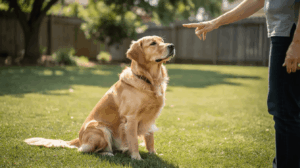
Teaching a dog to stay is one of the most valuable obedience skills an owner can develop, and one of the most misunderstood. The stay cue goes beyond a simple party trick. It can help an owner manage open doors, visitors, walks, and other everyday situations. However, no trained cue should be treated as a guaranteed safeguard near traffic or during a dangerous encounter. Whether you have a high-energy puppy or an adult dog that needs additional training, a reliable stay can make everyday life easier.
This step-by-step guide covers everything from foundational cues to advanced distraction training. You’ll learn the three D’s framework, how to establish a release cue, how to progress at your dog’s pace, and how to troubleshoot the problems that commonly interrupt training. Aggression, serious reactivity, and other high-risk behavior concerns require individualized professional evaluation and are outside the scope of this guide.
The direct answer: Teaching a dog to stay means teaching the dog to maintain a chosen position until a release cue or another clearly trained instruction is given. This is accomplished by gradually developing three variables: duration, distance, and distraction. Increasing one variable at a time often makes the lesson clearer and more manageable.
By the end of this guide, you will:
- Understand the three D’s framework so you can build duration, distance, and distraction gradually
- Support safer everyday management around doors, visitors, walks, and other appropriate situations
- Build position-holding skills through structured, consistent practice
- Work toward greater reliability in different environments
- Troubleshoot common training issues such as breaking early, difficulty with distance, and distraction sensitivity
Understanding the Stay Command Foundation
The stay cue generally asks a dog to maintain a chosen position until a release cue or another trained instruction is given. Some trainers distinguish “stay” from “wait,” using “wait” for a temporary pause and “stay” for a more formal position. Others use the cues differently. The specific words matter less than giving each cue a clear, consistent meaning.
Stay can support safety and everyday obedience, but it should not be treated as fail-safe. Use a leash, secure barrier, or other appropriate management near traffic, open doors, or reactive situations. A 2025 peer-reviewed study found that formal training did not uniformly improve performance on a separate measure of canine self-control. This supports treating stay as a specific skill that must be practiced in different settings rather than assuming it automatically creates general self-control.
Prerequisites for Stay Training
Before teaching stay, your dog should understand the position you want them to maintain. Stay can be taught from a sit, down, or stand, although many owners begin with sit because it is familiar and easy to reinforce. If your dog does not yet respond comfortably to the chosen position cue, work on that foundation first.
A consistent release cue also gives the exercise a clear ending. Without one, the dog may have difficulty determining when the exercise is complete. The position cue, stay cue, and release cue create a clear training sequence.
The Release Cue System
A release word signals that the stay exercise has ended. Common options include “free,” “break,” “release,” and “okay.” Any consistent cue can work, although a distinctive word may be easier to separate from everyday conversation.
To teach it, place your dog in a familiar position. Say the release word in an upbeat tone, then encourage the dog to move. Mark and reward the movement. Repeat in short sessions until the dog begins to associate the cue with permission to leave the position.
Once the release cue is familiar, you can begin building the stay through duration, distance, and distraction.
The Three D’s Training Method
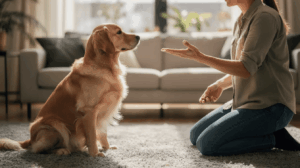
The three D’s of dog training are duration, distance, and distraction. Each variable can make a stay more difficult. Increasing one while keeping the others easy often helps the dog understand the exercise and succeed.
Duration Training
Duration is often the easiest place to begin. Ask your dog to take the chosen position, give the stay cue, pause for one or two seconds, then mark and reward while the dog is still in position. Give the release cue after the reward.
Increase the time gradually based on your dog’s success. Occasionally return to an easier interval rather than making every repetition longer than the last. There is no universal duration a dog must reach before progressing. Keep sessions short enough that your dog remains comfortable, responsive, and interested.
Distance Training
Once your dog can maintain a brief stay comfortably, begin adding small amounts of distance. Shift your weight or take one small step back, return promptly, and reward while your dog remains in position. Increase distance gradually while temporarily keeping the duration and distraction level easy.
During early training, returning to the dog for the reward helps emphasize remaining in place. A recall from a stay can be taught later as a separate exercise using a clear recall or release cue. Practice returning from different angles gradually without making the exercise too difficult.
Distraction Training
Introduce distractions gradually, beginning with something mild, such as a small movement, a quiet sound, or another person standing at a distance. When adding a distraction, reduce duration and distance so the dog has a reasonable chance of succeeding.
Practice in different environments to improve generalization. Move from a quiet room to another part of the house, then to a secure yard or another appropriate setting. Reduce the difficulty whenever you change locations, and use a leash or long line where needed for safety.
With the three D’s framework understood, you can translate it into a practical training process at home.
Step-by-Step Training Implementation
Begin in a quiet space with minimal distractions. Use rewards that are safe, motivating, and appropriate for your dog. Keep each session short enough that your dog remains engaged.
Phase 1: Building Duration
Begin indoors in a calm, familiar room with minimal distractions. Your initial goal is not a specific number of seconds. It is helping your dog understand that remaining in position leads to reinforcement.
- Ask your dog to sit, lie down, or stand.
- Give the verbal stay cue, with a consistent hand signal if desired.
- Pause briefly while your dog maintains the position.
- Mark and reward while your dog is still stationary.
- Give the release cue to end the exercise.
- Gradually vary and extend the duration across successful repetitions.
Practice a few short sessions when your dog is comfortable and receptive. If your dog breaks the stay, reset calmly without punishment and make the next repetition easier. Progress varies by dog, so avoid attaching the exercise to a fixed completion date.
Phase 2: Adding Distance
Once your dog understands a brief stay, introduce small amounts of movement and distance while keeping the duration short.
- Begin with a comfortable, brief stay.
- Shift your weight or take one small step away.
- Return promptly and reward your dog in position.
- Increase the distance in small increments as your dog succeeds.
- Practice easy returns from the front and side before adding more difficult angles.
Keep sessions short and upbeat. If your dog moves as you step away, reduce the distance or practice smaller body movements. Avoid leaning forward or using gestures that resemble your recall cue.
Training Environment Comparison
| Environment | Likely Challenge Level | Recommended Adjustment |
| Familiar indoor room | Usually lower | Begin with brief duration and little or no distance |
| Secure yard | Variable | Reduce duration and distance while the dog adjusts to sounds and smells |
| Appropriate public setting | Usually higher | Use a leash, increase distance from distractions, and return to easier criteria |
Pace progression according to your individual dog’s learning history, health, emotional state, and response to the environment. Puppies and dogs that are anxious, reactive, or easily distracted may need shorter exercises and more distance from distractions. Seek qualified professional help when behavior presents a safety concern.
A 2025 study of play after training produced mixed findings about whether play immediately after training improves retention of sit-and-stay behavior. One experiment found a possible benefit for dogs at an early learning stage, but a second experiment did not reproduce that result. Play can still be an enjoyable way to finish a session, but it should not be presented as a guaranteed method for improving retention.
Common Training Challenges and Solutions
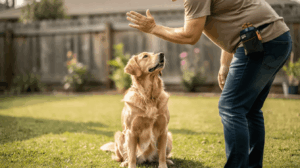
Even with a systematic approach, dogs may encounter challenges during stay training. Here is how to address the most common issues.
Dog Breaks the Stay Position Early
When your dog breaks the stay before the release cue, remain calm and avoid punishment. Reset the exercise and make the next repetition easier by reducing duration, distance, or distraction. The goal is to create successful practice rather than repeatedly testing the dog to failure.
Dog Won’t Stay When the Owner Moves Away
Difficulty when you move away can result from increasing distance too quickly, unclear body language, environmental distractions, or uncertainty about the exercise. Return to close-range practice and introduce small movements, such as shifting your weight or turning slightly, before taking a full step.
In appropriate environments, a leash or long line can provide added safety, but it should be handled under supervision and kept clear of obstacles.
Dog Is Distracted by Food or Other Dogs
Begin with mild distractions and increase their intensity gradually. If a food bowl is too difficult, place it farther away or use a less valuable item.
When other dogs are present, work at a distance where your dog can remain comfortable and responsive. Do not continue closing the distance if your dog shows fear, fixation, barking, lunging, or other signs of distress. Serious reactivity requires individualized professional guidance.
Dog Only Stays in Certain Locations
Dogs do not automatically apply a learned behavior to every setting. Your dog may hold a stay in the living room but struggle in the backyard because the sights, sounds, and smells have changed.
Treat each new environment as a temporary increase in difficulty. Reduce duration and distance, reinforce easy successes, and rebuild gradually. Maintain consistent verbal cues and hand signals across locations.
Conclusion and Next Steps
Teaching a dog to stay requires gradual development of duration, distance, and distraction. A useful stay begins with a clear position cue, builds through successful repetitions, and ends with a consistent release cue. Adjust one variable at a time whenever possible, and reduce the difficulty when your dog becomes confused or unsuccessful.
Begin by choosing a position and release cue, making sure your dog understands the position before adding stay. Practice a brief stay indoors, mark and reward your dog while they remain in position, and keep each session short enough to maintain their comfort and attention. Increase only one training variable at a time, and return to an easier version whenever your dog struggles.
If your dog has serious reactivity, anxiety, aggression, mobility limitations, or another concern that complicates training, consult a veterinarian or qualified training professional. Professional instruction can provide an individualized plan, but no trainer or program can guarantee that a cue will hold under every condition. You can also contact us to discuss your dog’s needs and available training options.
Frequently Asked Questions
How long should I initially ask my dog to stay?
Start with a brief pause of approximately one or two seconds. Reward your dog while they remain in position, then release them. Increase the duration gradually according to your dog’s comfort and success rather than working toward a universal time requirement.
Should I use treats or praise when teaching stay?
Use small rewards that are safe and appropriate for your dog. Food, play, and praise can all reinforce a stay, although their value varies between dogs. Once the behavior becomes reliable, begin varying the type and frequency of rewards rather than removing reinforcement abruptly.
Can I teach stay if my dog doesn’t know sit yet?
Stay can be taught from a sit, down, or stand. Your dog should first understand whichever position you choose so the lesson remains clear.
What if my dog breaks the stay early?
Calmly reset the exercise without punishment. Reduce the duration, distance, or distraction so the next repetition is easier, then build back up gradually.
Can I call my dog to me from a stay?
Yes, but it is usually easier to return to your dog during early stay training so remaining in position receives most of the practice. Later, you can teach a recall from a stay as a separate exercise by using a clear recall or release cue.
How do I help my dog stay reliable in distracting environments?
Introduce distractions gradually after your dog understands the basic exercise. Practice in different locations, increase distance from difficult distractions, and temporarily reduce the duration or distance whenever you enter a more challenging environment.
